Why do we need a new framework?
The conventional economic model is based on Homo Economicus: a rational, self-interested human driven by financial gain, ignoring qualities like altruism and community.
This growth-centric, GDP-focused view shapes organizations, R&D, and education, leading to cultural and economic disparities, anomie, and binary thinking between capitalism and socialism.
Systems built on competition and exploitation result in rigid hierarchies, widening inequality, and a lack of true equilibrium - highly disconnected from the need for a more pluralistic world in the times of polycrisis!
Answers to the frequently asked questions.
What about the work done globally in critiquing the mainstream economics?
Significant research has critiqued measuring organizational success solely by share price and national value by GDP. The Stiglitz, Sen, & Fitoussi (2008) report calls for broader indicators of progress, but also notes that it does not address organizational culture or "how" success is achieved
What about alternatives that have already been proposed?
Various organizations and organization development scholars and practitioners have explored alternatives to the dominant neoclassical theory of the firm. In these, different evolutionary pathways such as the reason for the existence of the firm as going beyond profits (Orts, 2023), a self-managed culture where management is based on autonomous teams and peer relationships (Laloux & Wilber, 2014), and the idea of multiple dimensions in measuring organizational performance (Hubbard, 2009) have been examined. The limiting factor in their adoption has been lack of alignment across these pathways and the central question of performance measurement, which is especially challenging in the case of non-financial indicators.
Why have metrics at all and make it complex?
The field of measurement itself has often, in the alternative world, earned a poor reputation simply because of an over-engagement with metrics. This is true. At the same time, measurement (of different kinds) brings a common framework for dialogue and improvement. We believe that the current set of measurements which are often not representtive of the reality on the ground is the real issue. In any organization, the question of return on investment comes up; having various dimensions to this can enrich what we consider as a good "return"! The question of the theory of the firm in today’s context of the poly-crisis cannot be answered without due regard to the underlying institutions, the measurement models and therefore issues of incentive alignment
A dharmic perspective to the individual, organizations, commons, and measurement - a response to the polycrisis
Social Theory: The idea of "human"
A renewed idea of “Man” that goes beyond that of Homo economicus and even ideas that hinge on altruism and reciprocity to a deeper sense of a dharmic foundation...
Read moreCreating an active commons & community
A new model for a Dharmic Sangha for such individuals to thrive, create value, and embark on a continuous learning journey as a collective through introspection...
Read moreBeyond hierarchical or "flat" organizations
As organizations grow, they tend to become rigid and hierarchical stifling innovation; and those that seek alternatives, often swing to the other extreme leading to ad-hocism or dialogue-fatigue from excessive consensus building.
Read moreA holistic framework of measurement
Sankhya posits that when a dharmic action is engaged with, one moves towards vairāgyam (restraint), jñānam (insight), aiśvaryam (abundance). Lakshmi is used in common parlance to describe this sense of abundance creating a context for learning and evolution.
Read moreThe Social Theory: the idea of a human
The Homo Economicus model sees individuals as rational actors maximizing personal utility, making macro outcomes and values traceable to micro-decisions (methodological individualism). While behavioral economics introduced limits and emotions, the core notion remains largely unchallenged. Current models, including natural capital, treat land as a resource for use, ignoring stewardship and replenishment. Post-WWII, Bretton-Woods institutions, allied with the military-industrial complex, accelerated these ideas and today's global crises.
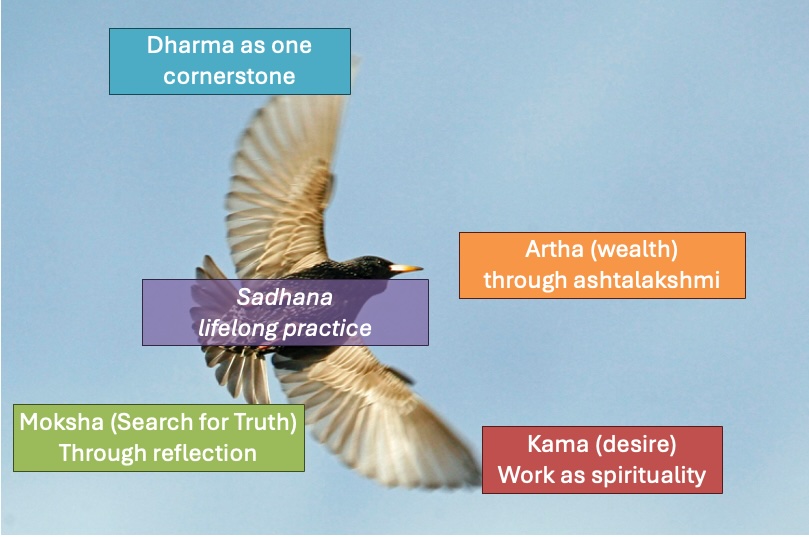
To build alternatives, assumptions must shift: individuals relate to systems, experience holistic well-being, pursue livelihood while nurturing Earth, with intergenerational responsibility and purpose defined by puruṣārtha framework (as defined in Yoga). That is, to redefine wealth (artha), find expression for one’s desire (kāma) and simultaneously be on the path of inner freedom (mukti / mokṣa); thereby becoming stewards (lens of dharma).
This is a path for the householder who is engaged with the world and wishes to do so meaningfully; where one is neither a cog-in-the-wheel nor an ascetic. We call this idea of a human as "Homo Dharmicus".

Creating an institutional environment
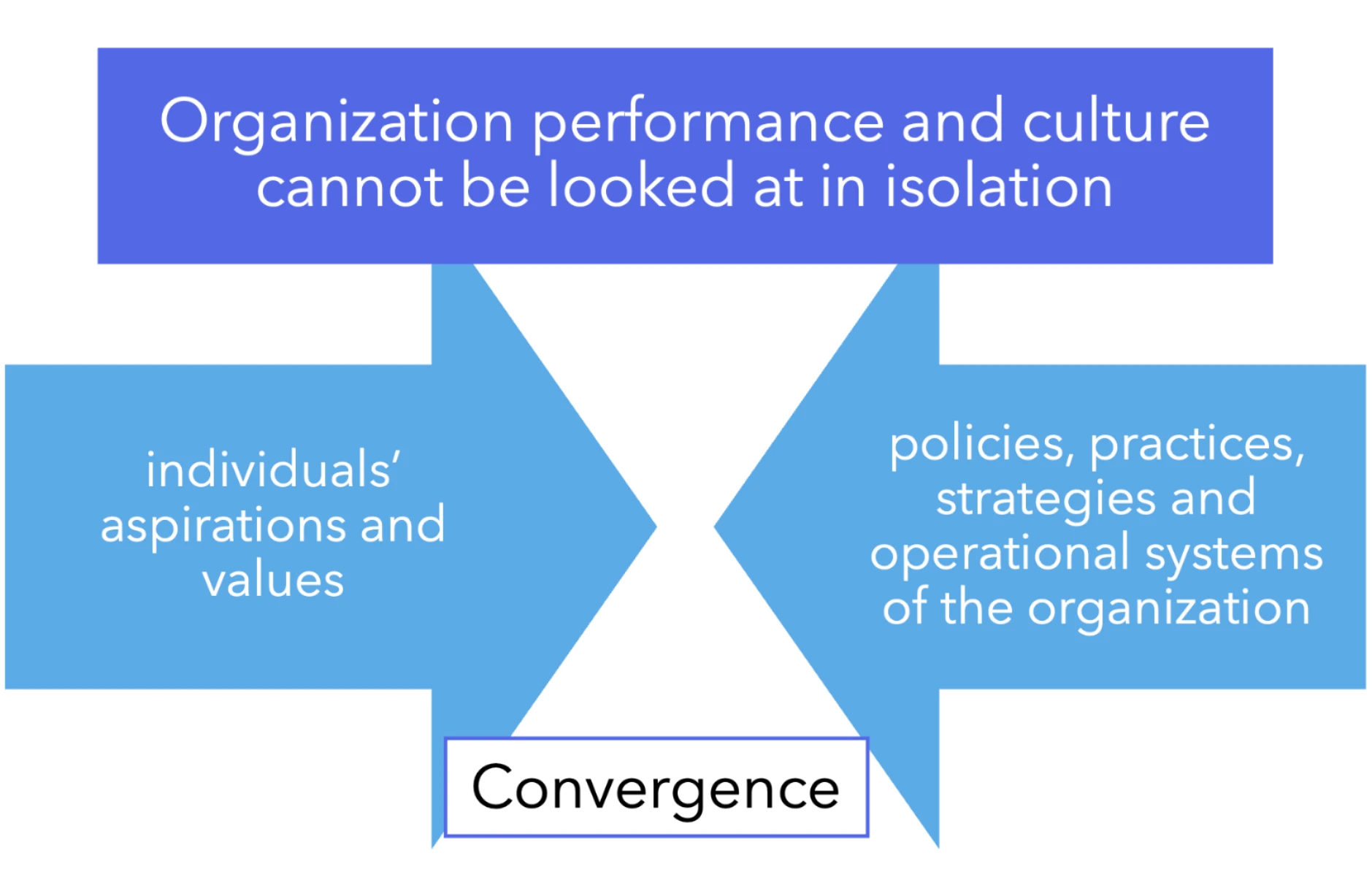
Every system has two parts to it: one that is most visible is how people relate to one another in delivering the outcome - we call this the organizational environment which operate on the primacy of roles (while also keeping the morale and human-ness in mind). The other is how people relate to each other beyond these roles.
How do members help each other grow?
How do they step back and examine the fundamental nature of the system that is created?
How do they weave hearts?
The ideas on koodam and other social group processes (sangha) discussed in the Mahabharata lends the idea of a group holding each member accountable to this process while keeping the interest of the larger society in mind. Such Dharmic organizations focus on transformation of self and the system in service of the larger context
The organization structure
Our fundamental aspiration here is to bring in a deep sense of self-and-system simultaneity. Naturally, the strategizing framework needs to come from a similar "mindset". Imagine having to study the quantum world and one has only tools from classical mechanics!
Even as organization structures are experimented with, on the ground, two distinct mindsets continue to operate: the traditional hierarchical mindsets that is role-bound, status-seeking and creates dependencies As a reaction, the younger individualistic mindset that demands freedom often without accountability How do we evolve to a “middle ground”? One that can be innovative and responsive to the context while retaining autonomy, reciprocity and resilience?
The TAO Tensegrity Mandala provides a fresh new way of looking at the organization. It brings together a dialogic process of arriving at an organizational structure, a framework to look at organizational outputs and outcomes, and creating roles and building capacities to achieve this (heart+head+hands) A brief overview of this is presented in the series of images in this section


The Ashtalakshmi
A Dharmic firm enables each individual and the firm itself to discover the best that they can be! The progress of the firm, its members and the impact on the larger context can be measured through the lens of Ashtalakshmi - an octet necessary and sufficient in this context to explore the various facets of an organizational action impact.
ASHTALAKSHMI AND THE IMPLICATION IN AN ORGANIZATION
|
Wealth dimension
|
Evocative questions for Organizational implication
|
|
|---|---|---|
|
आदि लक्ष्मी (Ādi Lakśmi) primeval goddess
|
Primary wealth comprising spiritual and ecological: space, time, air, water, minerals, climate, etc.
|
What is the reason-for-being of the organization? What is the nature of alignment of teams and individuals with this? And the nature of alignment with their own aspirations?
|
|
धान्य लक्ष्मी (Dhānya Lakśmi) grain goddess
|
Agricultural wealth comprising grains, food and nutrition
|
Efficiency in the throughput; what kind of metrics will we have to understand excellence, quality, deliverability
|
|
धैर्य लक्ष्मी (Dhairya Lakśmi) courage goddess
|
Inner/psychological Wealth comprising resilience, endurance, fortitude, patience, courage, initiative, enterprise
|
Set of enlivening behaviours across roles – that value friendship, bias-to-action, self-authorship
|
|
गज लक्ष्मी (Gaja Lakśmi) elephant goddess
|
Animal wealth comprising livestock, marine stock, bio-diversity
|
Organizational memory and legacy – what are the areas for which we wish to be known for in the world. What processes will we have to bring in a sense of culture, well-being and community?
|
|
सन्तान लक्ष्मी (Santāna Lakśmi) progeny goddess
|
People wealth comprising human capital, health, and wellness
|
What kind of succession planning and growth can we bring in the organization? What does our leadership pipeline, process of learning and development we wish for?
|
|
विजय लक्ष्मी (Vijaya Lakśmi) success goddess
|
Success wealth comprising achievement, excellence, victory, success, progress
|
What are our goal setting processes? How do we set up the organization for success in terms of the nature of teams, organization structure and so on
|
|
विद्या लक्ष्मी (Vidyā Lakśmi) knowledge goddess
|
Knowledge wealth comprising knowledge capital, intellectual capital
|
What are the knowledge creation processes and spaces for innovation in the organization?
|
|
धन लक्ष्मी (Dhana Lakśmi) money goddess
|
Monetary wealth comprising finance capital, liquidity
|
What must be our profitability, investment capability, ROE and so on?
|
Source for Ashtalakshmi and Wealth dimension mapping: (Ashta Lakshmi Framework: Divine Perspective for Building Enlightened Enterprises - Brahmachari Sai Sambat)
The organizational impact questions have been added in discussion amongst members of the Institute and the larger community

Join our community of dharmic organizations committed to excellence and prosperity
© 2025 Ashtalakshmi Institute